
Built on Backlash: The Politics That Launched Marsha Blackburn — When Protest Replaced Democratic Process
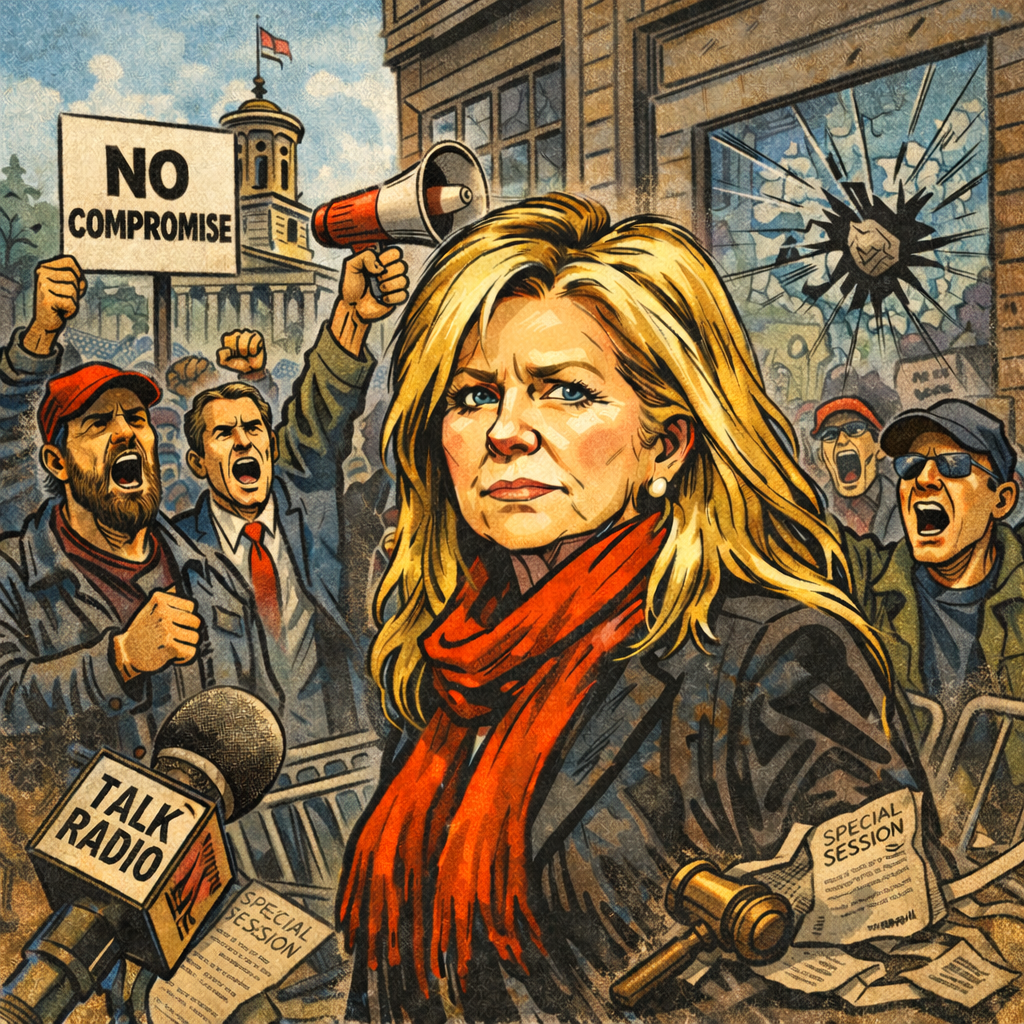
Illustration generated using ChatGPT (OpenAI), February 2026.
Marsha Blackburn was first elected to office when she won her state senate race in 1998. Her rise from the Tennessee Senate to the U.S. House in 2002 and eventually to the U.S. Senate in 2018 was not built on quiet governance or legislative craftsmanship. It was built on confrontation—most notably her leadership in the anti-tax movement that defined Tennessee politics in the early 2000s.
Between 1999 and 2002, Blackburn placed herself at the center of the fight against Governor Don Sundquist’s proposal to address a mounting budget crisis through a 3% state income tax. She used media—especially right-wing radio—to mobilize opposition. On July 13, 2001, during a special legislative session convened to debate the proposal, that movement boiled over into a volatile protest at the State Capitol.
Don Sundquist, a much better Republican than Marsha Blackburn will ever be, was attempting to solve a structural budget problem with what many economists would call a common-sense solution. Before the 2017 federal tax overhaul, taxpayers who itemized could deduct their state income tax payments from their federal taxable income, and there was no $10,000 cap as there is today. At the same time, voters tend to want the benefits of modern government without grappling with how we choose to structure the taxes that support it. At the state level, broad-based revenue typically relies on some combination of sales taxes and income taxes, alongside other sources like corporate taxes and fees. Sales taxes are regressive and disproportionately burden lower-income communities—even accounting for higher overall spending by wealthier households. Income taxes, by contrast, are typically structured more progressively and, at that time, were deductible at the federal level without a fixed cap.
Even if you disagree with me on tax policy, it is hard to argue that reliance on regressive taxation has done Memphis any favors over the years.
Now let’s return to July 13, 2001.
The protest that day drew roughly 2,000 demonstrators to the Capitol. The atmosphere escalated. Protesters pounded on the doors of the Senate chamber, shattered windows, and confronted legislators. A rock was thrown through a window of Governor Sundquist’s office, and a state employee injured his hand in the commotion.
There were no sweeping arrests. The special session was abruptly adjourned. The proposed income tax died.
Blackburn did not personally break windows. But she helped lead and energize the movement that produced that moment. The political pressure campaign worked. A loud, highly motivated faction of activists derailed a tax proposal intended to address a statewide fiscal problem.
Many of those protesters were upper middle class—individuals who perceived themselves as financially embattled while benefiting from a tax structure that already favored consumption over income. Their outrage carried the day. Tennessee’s more pragmatic wing of the Republican Party effectively lost the argument, and the state has not seriously revisited broad-based income tax reform since. Five years later, I was interning at the Tennessee Capitol for then-State Senator Steve Cohen. The internship program back then was outstanding. It made you one of only two or three staff members for a state representative or senator. It paid. It was full-time for the entire session. And the program director arranged regular opportunities for interns to hear from elected officials across the political spectrum.
During one of those gatherings, Marsha Blackburn came to speak to our bipartisan group.
Her speech quickly moved into the familiar and long-discredited claim that Iraq and 9/11 were connected. I sighed.
Those of you who know me understand that I do not do many things quietly. I can swear on Bernie Sanders that I did not yell or make a dramatic display. It was not a protest. It was not an ongoing disruption. It was a sigh—about what you would expect from me when listening to something I fundamentally disagreed with.
I did not shout. I did not interrupt. I did not throw myself on the floor or attempt to drown her out. Had I done any of those things, I would have deserved to be removed from the program.
But it was just a sigh.
Marsha Blackburn’s reaction was anything but measured. She raised her voice to the room—largely in my direction—and then stormed out. Friends from across the aisle later told me she went into Lt. Governor Ron Ramsey’s office and remained there for some time.
The internship coordinator later remarked, “If Marsha Blackburn cannot handle a group of bipartisan interns, I don’t understand how she can handle Congress.”
And now the Republican Party is asking us to elect her governor.
Governor of the same State Capitol where she helped mobilize the movement that shut down debate through intimidation and property damage. A politician who learned early that when a small group shouts loud enough, it can derail serious governance. Long before January 6 became shorthand for mob politics, Tennessee saw what happens when intimidation replaces deliberation.
On November 3, 2026, Tennesseans will decide whether we want a far-right opportunist who helped fuel a movement that pressured lawmakers into abandoning a tax debate—or whether we want a Democratic nominee prepared to govern seriously.
Whether July 13, 2001 or January 6, 2021, the lesson is the same: when outrage is allowed to overpower debate, democracy—our democratic republic—weakens. Civility is not weakness. It is a prerequisite for a functioning government.